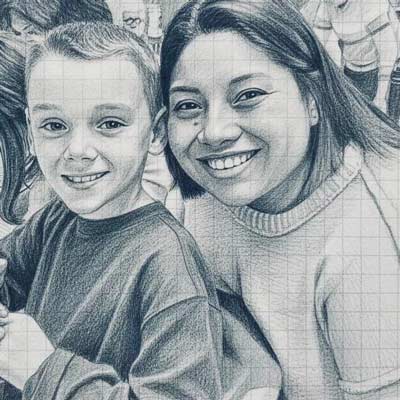
I started at Harley in Grade 7, and at first, the transition was hard. But it was absolutely worth it. The smaller class sizes and the relationships I built with my teachers made all the difference for me, both academically and emotionally. Harley quickly became a place where I felt known, supported, and challenged to grow.
I also feel a deep sense of pride in continuing the Harley legacy in my family. My dad (Bill Sykes ’76, GP ’36) came before me, and now my nephew, Bentley ’36, carries it forward. In a crazy coincidence, we all share the same Harley banner, the Crescent, which still feels a little surreal. It’s a powerful connection across generations, and one we hope will continue.
The most meaningful part of my Harley experience was Hospice with Bob Kane (English and Hospice, 2003-2013). This class remains one of the most powerful experiences of my life, and I still reference it today. Sitting here now, talking on Bob Kane’s heavenly birthday feels especially poetic. Hospice fundamentally changed who I was and how I engage with the world. It was one of the first times I realized I could make a real difference simply by showing up, spending time, and building a relationship with someone. I will never forget the intensity of that experience, or what it meant to have an adult believe that a 17 or 18-year old could carry such a profound responsibility. Looking back, it’s clear that this experience planted the seeds for my career as a mental health therapist.
History with Bill Schara (History 1997-2021, 2022-23) and Kristin Sheridan (History, 2007-present), also impacted me deeply. So many teachers showed me what it looks like to live a full, balanced life. Schara and Sheridan ran, gardened, read, listened to music, and cared deeply about their families. Kane was constantly engaged in outreach, meditation, travel, and teaching, and even rode a motorcycle. Juliana Floret (Spanish, 2007-2019) loved Zumba. They weren’t just teachers; they were whole, vibrant humans who engaged deeply with life and with others. That example still guides me as I think about the balance I want in my own life.
Harley encouraged both my academics and my passions. I still love to read, stay active in sports, and engage in my hobbies, and I love watching my nephew do the same now. There was always room for curiosity and passion alongside rigorous learning, and that balance mattered.
After Harley, I went on to graduate with a bachelor’s from Nazareth University and then a Master’s from Roberts Wesleyan. Harley absolutely prepared me for college, not just academically, but in helping me become the person I wanted to be. I learned to seek out opportunities to grow, explore the world around me, and give back.
My time at Harley has without a doubt influenced my career. I often reflect on the core values I learned there—curiosity, compassion, confidence, empathy, voice, authenticity, community, diversity, and passion—especially during challenging moments. Harley is one of my homes. It’s where my roots are. When I need direction, I think about what I accomplished there, the people who believed in me even then, and what is within my control now. I carry deep gratitude for the friendships that have stood the test of time, friendships I truly believe were shaped by the Harley experience. Even though I didn’t know what social work was before applying to graduate school, I trusted that I would find my way because Harley had instilled in me a deep belief in myself and my purpose.
If I could offer one piece of advice to students today, it would be this: do it all. It’s hard. It’s stressful. You will be exhausted. But do it all if you can—the arts, the academics, the projects, the experiences, the teams. I’m so grateful I had the chance to be a student athlete, to participate in Hospice, to learn how to ask questions, form opinions, build relationships, and always have a place to return to. Harley is not just a school. It is an experience.