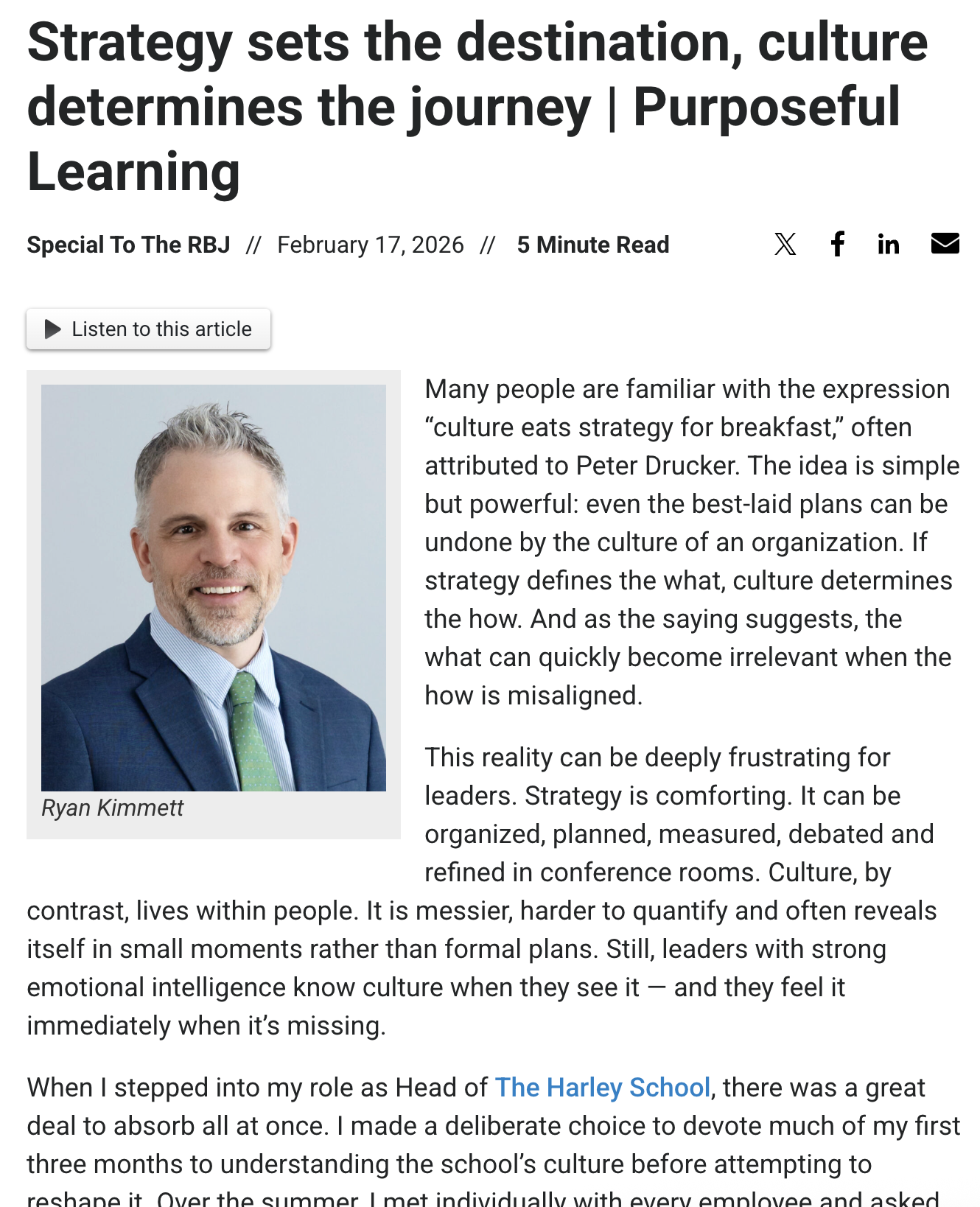
Purposeful Learning Special to the RBJ, February 17, 2026, by Dr. Ryan Kimmet • Culture vs Strategy in Leadership
Many people are familiar with the expression “culture eats strategy for breakfast,” often attributed to Peter Drucker. The idea is simple but powerful: even the best-laid plans can be undone by the culture of an organization. If strategy defines the what, culture determines the how. And as the saying suggests, the what can quickly become irrelevant when the how is misaligned.
This reality can be deeply frustrating for leaders. Strategy is comforting. It can be organized, planned, measured, debated and refined in conference rooms. Culture, by contrast, lives within people. It is messier, harder to quantify and often reveals itself in small moments rather than formal plans. Still, leaders with strong emotional intelligence know culture when they see it — and they feel it immediately when it’s missing.
When I stepped into my role as Head of The Harley School, there was a great deal to absorb all at once. I made a deliberate choice to devote much of my first three months to understanding the school’s culture before attempting to reshape it. Over the summer, I met individually with every employee and asked three simple questions: What about working here should never change? What needs to change? And what advice would you give to me as the new Head?
Taken together, responses from more than 100 employees provided a clear, nuanced picture of where the culture was strong and where it needed attention. Once the school year began, I complemented those conversations with a management-by-walking-around approach — maintaining a steady “temperature check” on how people were doing while remaining visible and accessible.
In business, strategy centers on market position, growth and competitive advantage. In education, the stakes are different, but the strategic challenge is remarkably similar. Curriculum serves as a school’s core strategic framework: a deliberate scope and sequence designed to build knowledge over time while preparing students for what the future may hold.
For schools, this is a sophisticated undertaking. The goal is to balance rigorous academic foundations with creative arts, athletics and social-emotional growth. True strategy in this context is found in intentionality — ensuring that every programmatic choice aligns with a clear purpose. But without a healthy culture, strategy falters quickly.
If teachers feel unsupported or undervalued, students feel it. Families feel it. Enrollment reflects it. Conversely, when teachers — who deserve to be among the most respected and well-compensated professionals in our country — feel trusted, supported and empowered to bring their expertise and creativity to their work, culture strengthens. The same is true for students. When young people feel safe enough to bring their full selves to school and take intellectual risks, learning accelerates. This is where leadership matters most.
Leaders in both schools and businesses are responsible not only for managing strategy — setting goals, establishing policies and communicating clearly — but also for actively tending to culture. While culture can feel abstract or beyond direct control, it is shaped every day by what leaders prioritize, model and reinforce.
Trust is foundational. Employees need to trust that leaders are authentic and reliable. Leaders need to trust their people to do their work well. This kind of trust takes time to build, but it pays significant dividends. When trust is high, communication is transparent and efficient. When trust is low, progress slows under the weight of extra meetings, memos and approvals. The healthiest organizations feel less like rigid hierarchies and more like villages — places where people feel known, supported and valued for their contributions.
The leader’s job is not to impose culture through slogans or mandates, but to create the cultural architecture in which people can thrive. That work is less about grand gestures and more about tone, presence and consistency. Every interaction is an opportunity to reinforce psychological safety, belonging and purpose.
This work often requires stepping out from behind a screen to be present where the work is happening. It might be as simple as a personal note to a colleague or spending time on the “front lines” of our operations. These small touchpoints are often the most meaningful parts of my day because they build a bridge between leadership and the daily experience of our staff. I’ve begun scheduling short, non-evaluative visits to observe various teams in action. It matters deeply to me to see our mission being executed at every level. This visibility allows me to advocate for our culture with genuine specificity, rooted in the talent I see every day.
Students who grow up in schools with strong, healthy cultures carry those experiences with them into the workplace. Collaboration, self-advocacy, resilience and empathy are not merely academic outcomes; they are cultural habits. In that sense, schools and businesses are deeply aligned. Both are, at their core, in the people-development business.
Every leader knows how full the days are. We lose sleep over decisions, metrics and outcomes. But making time — consistently and intentionally — to invest in relationships and trust is not a distraction from the work. It is the work.
Strategy may set the destination, but culture determines the journey. Tend not only to the boardroom, but to the village itself. When culture is strong, strategy has a chance to succeed. When it is weak, no amount of planning will save the quarter.
Dr. Ryan Kimmet is the Head of School at The Harley School and a veteran leader in independent education. His column explores the intersection of K–12 innovation, workforce development and the regional economic impact of modern schooling.
Link to the RBJ column, “Culture vs Strategy in Leadership”.