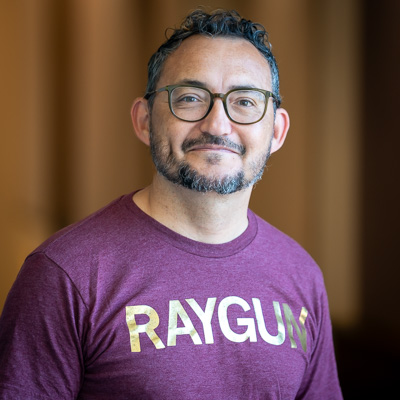
When Rodrigo Gutierrez joined The Harley School in 2021, he brought with him nearly two decades of experience teaching history across the country—from Texas to Connecticut, Delaware, Arizona, and most recently, Allendale Columbia. With degrees from Yale University and the University of Texas at Austin, he initially planned to study economics or pre-med, but history was always his favorite subject.
When he discovered Yale’s teacher preparation program, he decided to pursue it, earning certification and later completing a master’s degree in European History where he did his dissertation on witchcraft in 15th-century Spain.
At Harley, Rodrigo teaches Modern Global Studies, where students explore how the world has evolved since the 1700s. One of his favorite projects is a hands-on 3-D timeline that challenges students to visualize world events in creative ways. “They have to include at least ten major events, and some of it has to be interactive—movable pieces or photos,” he says. While it is one of his favorite projects, students get pretty into it, too! Some students choose to work on their own while others collaborate with two or three others.
Rodrigo believes deeply in the importance of perspective. In his classroom, students are encouraged to share their opinions, even—and especially—when they differ. He shares that the key for making kids feel comfortable is to be open and intentional when you listen. “I try to bring in readings from multiple viewpoints so both sides are represented. Sometimes students even have to argue a side they disagree with.” He says it can get heated, but it’s never gotten out of hand.

What Rodrigo hopes students take away from his class goes far beyond memorizing dates or names. He wants them to see history as a living story—one that helps them understand themselves and the world they inhabit. By exploring how past choices shaped issues like climate and discrimination, his students begin to recognize their own power to influence change. For Rodrigo, history isn’t just about what happened; it’s about how we continue to shape what happens next.
At Harley, Rodrigo has discovered that students learn best when they can engage directly with the material—building, creating, and exploring rather than sitting through lectures. This has inspired him to make his teaching more student-centered and hands-on, helping students connect with history in meaningful ways. He’s also energized by his colleagues, a diverse and collaborative group that he learns from every day.
For Rodrigo, teaching history is as much about shaping the future as it is about understanding the past—helping students see how everything is connected and how they each play a role in the story that continues to unfold.