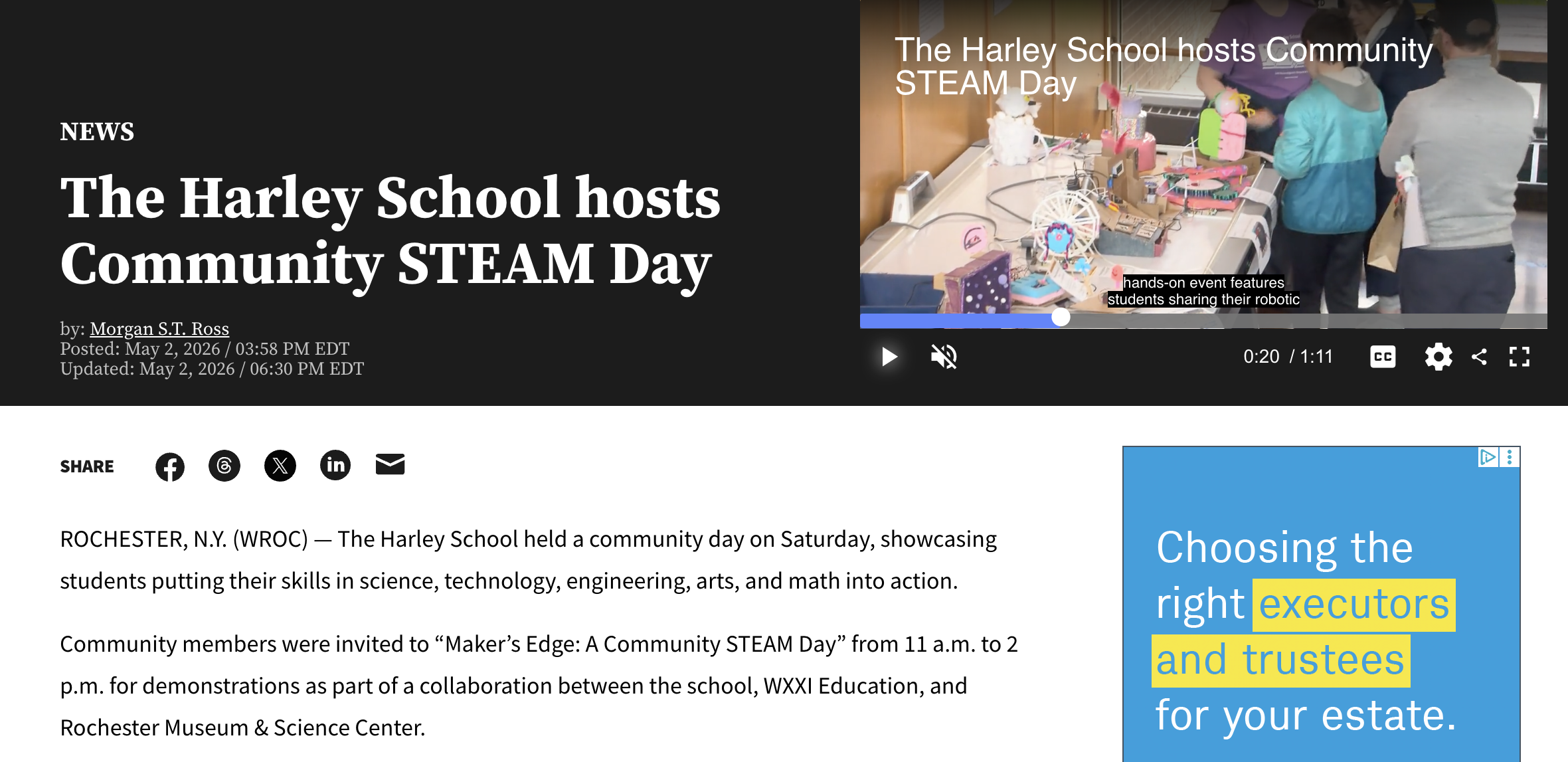
ROCHESTER, N.Y. — On a vibrant Saturday in May, the halls of The Harley School were transformed into a sprawling laboratory of creativity and technical prowess. The school hosted its highly anticipated community event, “Maker’s Edge: A Community STEAM Day,” a celebration that invited the Greater Rochester public to witness firsthand how students are bridging the gap between classroom theory and real-world application.
The event was far more than a typical school exhibit. Described by organizers as a hybrid of a high-energy science fair and a modern makers festival, Maker’s Edge was designed to showcase the integration of Science, Technology, Engineering, Arts, and Mathematics (STEAM). In a powerful display of community synergy, the day was held in strategic collaboration with WXXI Education and the Rochester Museum & Science Center (RMSC), two of the region's stalwarts for lifelong learning.
A Campus Transformed
As visitors moved through the campus, the atmosphere was electric with the hum of student-built robots and the excited chatter of families engaging in interactive experiments. From the Lower School to the Upper School, the curriculum was on full display. At one station, younger children experimented with the physics of flight, while just a few feet away, high school seniors explained the complexities of circuit design.
“It’s just fun to see Harley students and community members who heard about this through other channels come through our space to learn about the school and the different opportunities we have,” said Rachel Healey, a Harley parent who volunteered at the event. “STEAM isn't just a buzzword here; it’s a massive, foundational part of the curriculum that encourages kids to think like designers from day one.”
The Cross-Disciplinary Approach
One of the standout exhibits came from Charles Clark, a junior at Harley, whose project perfectly encapsulated the school’s "cross-class" philosophy. Clark showcased a fully functional photobooth—a project born not from a single assignment, but from a fusion of interests.
Inspired by his work in a yearbook class, Clark realized he could automate the process of capturing and distributing memories. He spent weeks utilizing skills honed in his multimedia journalism and computer science classes to build the physical booth and, perhaps more impressively, code a custom website that allows users to access their photos digitally in real-time.
“There are a lot of classes here that help with projects like this,” Clark told News 8. “Since I'm taking multimedia journalism and computer science, I actually worked on the website during my CS class. It’s a true cross-class project. The school helped a lot by providing the resources I needed—they gave me the time in the schedule and even supported the technical side by purchasing the specific photo printer required to make it work.”
Real-World Stakes: NASA and Beyond
The sophistication of the work on display reached a pinnacle with the projects from NASA’s HUNCH program (High school students United with NASA to Create Hardware). Harley students involved in this elite partnership displayed "real-world design work" intended for space exploration. These aren't mere models; they are prototypes designed to solve actual problems faced by astronauts on the International Space Station (ISS).
By participating in the HUNCH program, Harley students are tasked with meeting NASA’s rigorous engineering standards, providing them with a level of "industrial-grade" feedback rarely seen in secondary education. It serves as a testament to the school's commitment to providing students with a platform where their work has consequences and value far beyond the campus gates.
A Model for the Future
As the day concluded, the message was clear: The Harley School is not just teaching students how to use technology; it is teaching them how to innovate within a community. By opening their doors to the Rochester public and partnering with organizations like WXXI and RMSC, Harley is fostering a regional ecosystem of curiosity.
Maker’s Edge proved that when you give students the resources, the time, and the cross-disciplinary freedom to explore, they don't just "do schoolwork"—they build the future. For the families in attendance, it was an inspiring glimpse into what is possible when education meets imagination.