The following was originally published in the Rochester Business Journal.
When people discuss economic development, they usually talk about attracting businesses, supporting entrepreneurs, building infrastructure or recruiting talented workers from elsewhere. Rarely does the conversation turn to a preschool classroom. Yet if Rochester hopes to strengthen its economy over the next 20 years, some of the most important work may already be happening there.
If you were to walk through the classrooms and outdoor spaces of a high-quality early childhood program, you would find learning-rich environments at every turn. Shelves would be lined with books. Blocks and other open-ended materials would invite children to build, experiment and create. Dramatic play areas would encourage imagination and collaboration. Just beyond the classroom, outdoor spaces would offer additional opportunities for exploration, discovery and play.
More importantly, you would find a culture in which children feel safe, known and valued. In these environments, educators help children develop the foundational skills that support future learning, not only early literacy and numeracy, but also the social and emotional capacities that allow us to work with others, regulate our emotions, solve problems and contribute to a community.
These classrooms, and the remarkable educators who lead them, build the foundation for success in kindergarten and beyond. Children who attend high-quality early childhood programs demonstrate stronger language development, greater school readiness and more sophisticated social-emotional skills. Families benefit directly from these outcomes, but the benefits extend well beyond individual children. Higher educational attainment, greater economic mobility, a stronger workforce and increased tax revenues all represent public returns on these early investments.
While all education creates both private and public value, early childhood education may be the most powerful example because of what we now understand about human development during the earliest years of life.
By age five, approximately 90 percent of brain development has already occurred. The years before kindergarten are not merely preparation for school, they are the period during which the brain’s foundational architecture is built. High-quality early childhood environments help children develop working memory, self-regulation and mental flexibility. These are the skills that later support collaboration, leadership and problem-solving.
A child who develops strong foundational skills at age three gains more from every subsequent educational opportunity. Economists sometimes describe this phenomenon as “skill begets skill.” Early childhood education is not simply one educational investment among many; it increases the effectiveness of all the investments that follow.
Another way to examine the issue is to consider the cost of doing nothing. In 2026, the national childcare crisis was estimated to cost the U.S. economy $172 billion annually through lost earnings, reduced productivity and diminished tax revenues. Employers alone absorb tens of billions of dollars in costs associated with absenteeism, turnover and workforce disruptions.
Conversely, economist James Heckman’s long-term research on high-quality birth-to-five programs demonstrates annual returns approaching 13%. Unlike many investments, these returns emerge across multiple dimensions: higher earnings, better health outcomes, greater workforce participation, lower remediation costs and reduced criminal justice expenditures. The most expensive problems are often those addressed too late. Investments made during the years of greatest developmental opportunity reduce future expenditures on remedial education, healthcare interventions, social services and the criminal justice system.
The question, then, is not whether early childhood education creates value. The question is what these findings mean for Rochester.
The answer is that Rochester faces many of the same challenges confronting communities across the country. Employers struggle to fill open positions. Parents search for affordable, high-quality childcare. School districts work to address readiness gaps among incoming students. Economic development leaders seek ways to attract and retain talented workers and their families. While these challenges are often discussed separately, they are more interconnected than they first appear.
Consider workforce participation. Childcare is often viewed as a family issue, but it is equally a workforce issue. Parents cannot participate fully in the economy if they do not have access to safe, reliable places for their children to learn and grow. When childcare options are limited, parents reduce their hours, decline promotions, postpone career opportunities or leave the workforce entirely. Businesses experience these consequences through staffing shortages, absenteeism and turnover. What appears on the surface to be a childcare problem quickly becomes an economic problem.
Rochester offers a clear example of this challenge. Local leaders have worked to expand access to early childhood programs, yet families continue to encounter shortages of available childcare slots and long waitlists for assistance. At the same time, providers struggle to recruit and retain qualified educators in a field where compensation often lags behind comparable professions. The result is a capacity challenge that affects not only children and families, but employers and the broader economy as well.
The effects are visible in our schools. Organizations such as Horizons at Harley, ROC the Future and The Children’s Agenda have highlighted persistent kindergarten readiness gaps among children entering school. These gaps do not reflect a lack of potential; they reflect unequal access to the early learning experiences that help children arrive prepared to thrive. When children begin school behind, districts must devote resources to remediation rather than acceleration. Communities ultimately pay more when they invest later instead of sooner.
Rochester is also investing heavily in its future. Our region is positioning itself as a center for advanced manufacturing, optics and photonics, healthcare and technology. These sectors require talented workers and innovative leaders. Much attention is appropriately paid to higher education, workforce training and talent recruitment. Yet it is worth remembering that the pipeline of future talent does not begin in college, high school or even middle school. It begins in the earliest years of life.
As Rochester seeks to grow these industries, the conversation often focuses on how to recruit talent. We should spend equal time discussing how to develop it.
Taken together, these realities suggest that we need to rethink how we categorize early childhood education. Rather than viewing it solely as a family service or educational program, we might better understand it as a critical form of economic infrastructure.
When we hear the word infrastructure, we typically think of roads, bridges, airports, or broadband networks. These are important investments because they make economic activity possible. Roads move goods. Broadband moves information. Early childhood education develops people.
Human capital remains the most valuable resource any community possesses. Every engineer, nurse, entrepreneur, teacher, scientist, skilled tradesperson and civic leader begins as a child. If we are willing to invest millions of dollars in physical infrastructure because it supports future economic growth, we should be equally willing to recognize the importance of the infrastructure that develops the people who will ultimately drive that growth.
The most important economic development work often looks nothing like economic development. It looks like a child sitting in a circle with their classmates, building a tower of blocks, negotiating roles in an imaginative game, learning to wait their turn or exploring the natural world alongside a caring teacher. These moments may appear small, but they are building the cognitive, social and emotional foundations upon which future success depends.
Every community eventually inherits the future it prepares for.
The children learning in Rochester’s early childhood classrooms today will one day become the employees, entrepreneurs, healthcare professionals, educators and civic leaders on whom our region depends. When we invest in early childhood education, we are not simply helping individual children or supporting individual families. We are making a long-term investment in Rochester itself.
That investment may take years to reveal its full return. Few investments, however, hold greater promise for the future prosperity, vitality and resilience of our community.
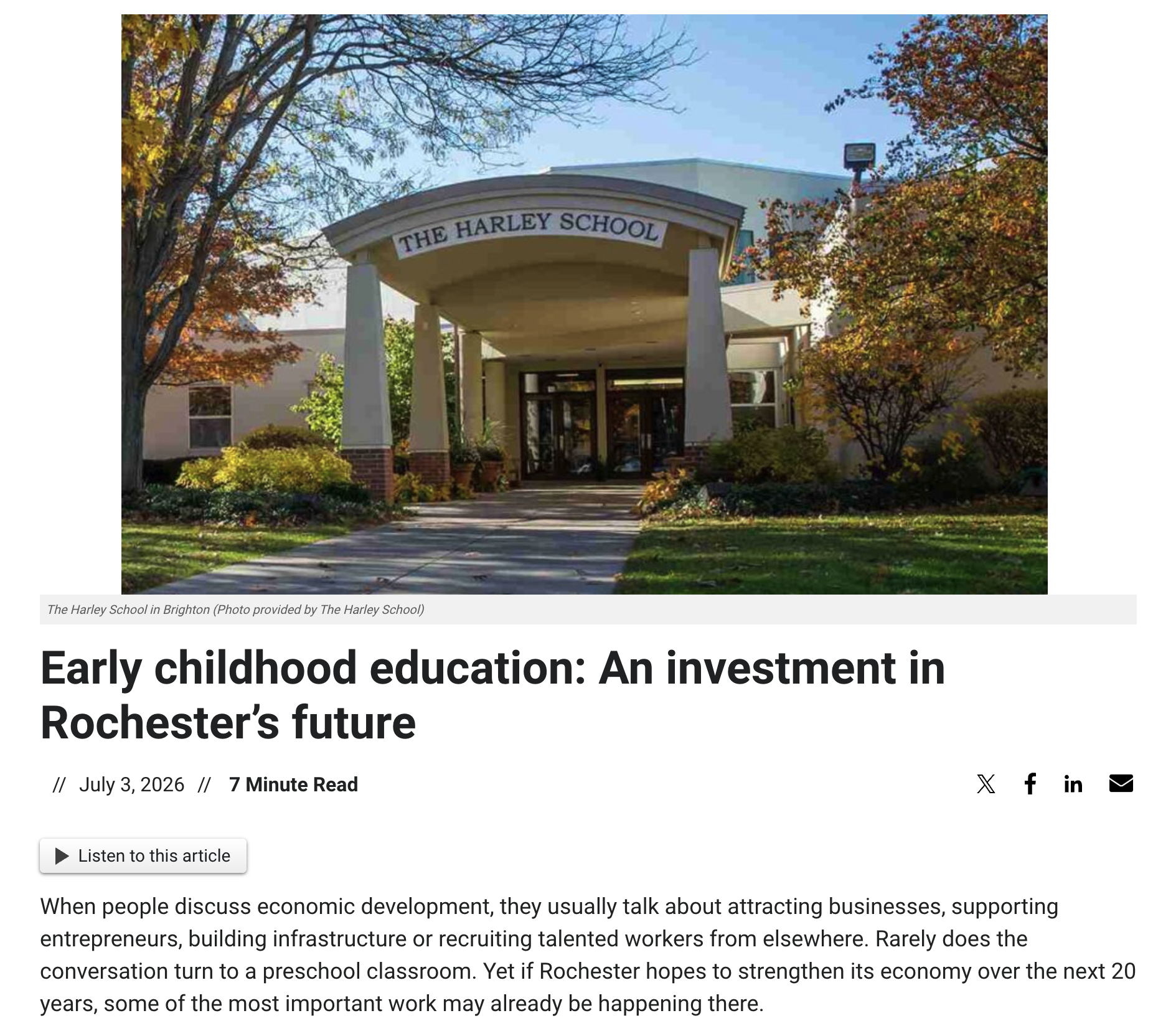
Dr. Ryan Kimmet is the Head of School at The Harley School and a veteran leader in independent education. His column explores the intersection of K–12 innovation, workforce development and the regional economic impact of modern schooling.