
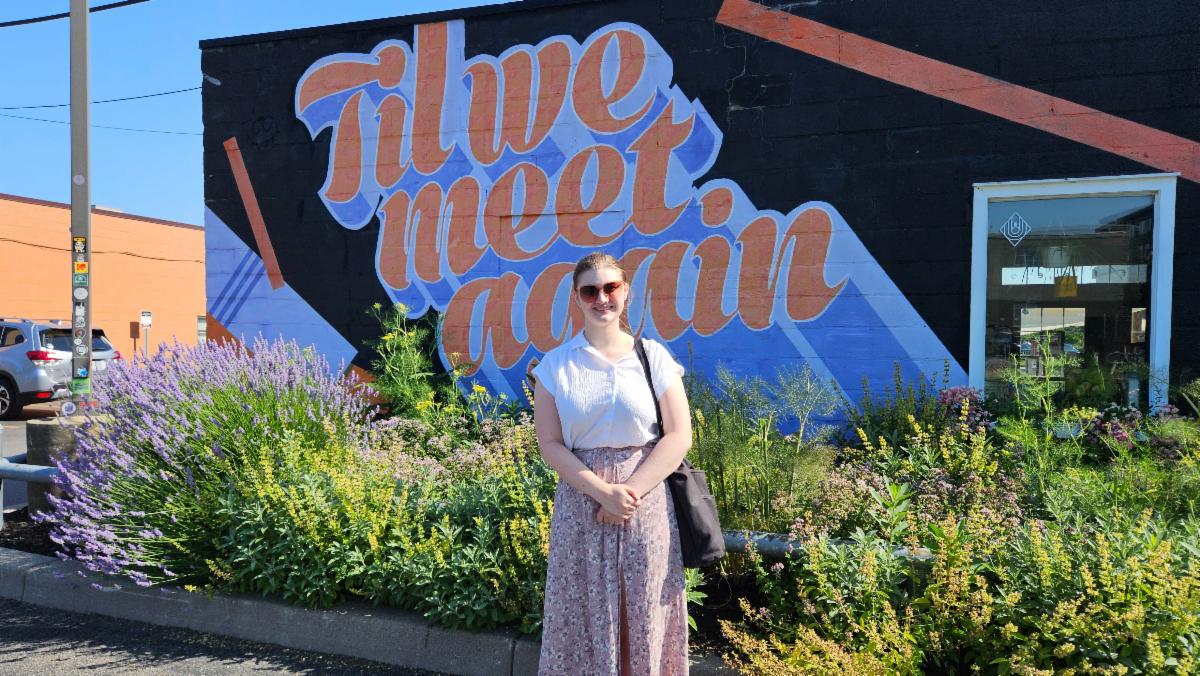
Audrey Scudder ’19 is a Harley “lifer,” starting her time at Harley as a three-year-old in Nursery Yellow. For Audrey, Harley has always felt like a second home—a place where she knew everyone and where the faculty and staff truly understood and supported her. It was also, “the first place I ever worked—and the only place I ever worked” for many years.
At Harley, Audrey experienced academic rigor that pushed her to grow. She credits Harley history teachers like Sandy Foster P ‘19, ‘19, History, 1997-2022, Bill Schara, History, 1997-2021, 22-23, and Kristin Sheradin, History, 2007-present, for their unwavering commitment to research and writing, recalling the “required papers we had to write every single trimester.” She also credits Dr. Betsy Vinton “DV”, Math and Science, 2001-present for introducing her to so many research skills through bioinformatics and James Aldrich-Moodie “JAM”, English, 1998-2003, Math, 2003-present, was a major influence in her sticking with Math through college. She also formed a strong connection with Lorie Rick, Physical Education, 1999-2025, both as a mentor and a role model.
Audrey started teaching swim lessons the summer after Grade 5 and worked with Lorie and Lindsay Worner ‘02 (Physical Education, 2010-2022, Middle School, 2022-25) through the summer of 2018 at Harley Day Camp and Horizons. She apprenticed under Lorie, Lindsay and alumni like Lily Frye ’12 and Emily Hanss ’13. It was under their guidance that she learn how to observe and support young children’s behavior—an early glimpse into the work she’d later pursue as a future psychologist.
When it came time to leave Harley, Audrey was looking for a liberal arts college that felt “like the University of Rochester—but not the University of Rochester.” She found that at Vanderbilt University in Nashville, drawn to the idea of starting fresh in a place where she didn’t know anyone. At Vanderbilt, she double-majored in psychology and math, played viola in the student orchestra, and became the go-to person for stats support on research projects. Her family jokes that she might stay in school forever—but Audrey’s path has never been about chasing degrees. It’s about purpose.
That purpose came into sharp focus during her freshman year, when the COVID-19 pandemic disrupted campus life. Back in Rochester, Audrey returned to Harley to be a “Harley Hybrid Hero,” teaching an online program for children of faculty and staff that didn’t attend Harley, but whose schools were not back in session. She also worked as a substitute in the Student Support Program, deepening her appreciation for Harley’s individualized, student-centered approach. While she had never aspired to be a teacher, those days of being a swim instructor were a time she really fell in love with the idea of teaching. By the time she went to college, though, she had decided that managing a full classroom of kids wasn’t her thing and really wanted to be involved in research of some sort. But, returning to Harley over Covid and working over the summer, did make her realize she had to stay connected to schools and working with kids somehow, even if it wasn’t as a “teacher” in the traditional sense. It was during this time she began to see herself as an educator.
Today, Audrey is pursuing a Ph.D. in Educational Psychology at the University of Connecticut. The five-year program blends rigorous coursework, research, and clinical work in a supportive cohort model—exactly the kind of environment, she discovered during the pandemic, that she thrives in. The program is better than she ever imagined. “If the job of school psychologist didn’t already exist,” she says, “it’s the job I would have designed for myself.”
Audrey’s current work focuses on ensuring educational tools are fair and effective for all students. She’s researching how children with autism perform on intelligence tests and working to make those assessments more equitable. She’s also developing wellness screening tools to support students’ social-emotional health. Twice a week, she works at a clinical day school for students with emotional regulation challenges—making sure her research remains deeply rooted in practice.
Looking ahead, Audrey hopes to one day teach the next generation of school psychologists as a professor—but also gain some experience within a school program. While she envisions a long-term future in academia, she’s committed to keeping one foot in the classroom, continuing to work directly with students.
From Harley hallways to graduate seminars and clinical settings, Audrey’s journey is a testament to the power of supportive communities, intellectual curiosity, and the belief that every child deserves someone who understands how they learn—and how to help them thrive.